At a Glance
The short version
Founded
1903, as the Overland Automobile Co.; reorganized as Willys-Overland, 1908
Founder
John North Willys
Headquarters
Toledo, Ohio
Peak Standing
America's #2 automaker, 1912–1918 (behind Ford)
Best Known For
The World War II Jeep
Later History
Sold to Kaiser, 1953 — became Jeep Corporation, ultimately today's Jeep brand
History
From a rescued startup to America's second-largest automaker
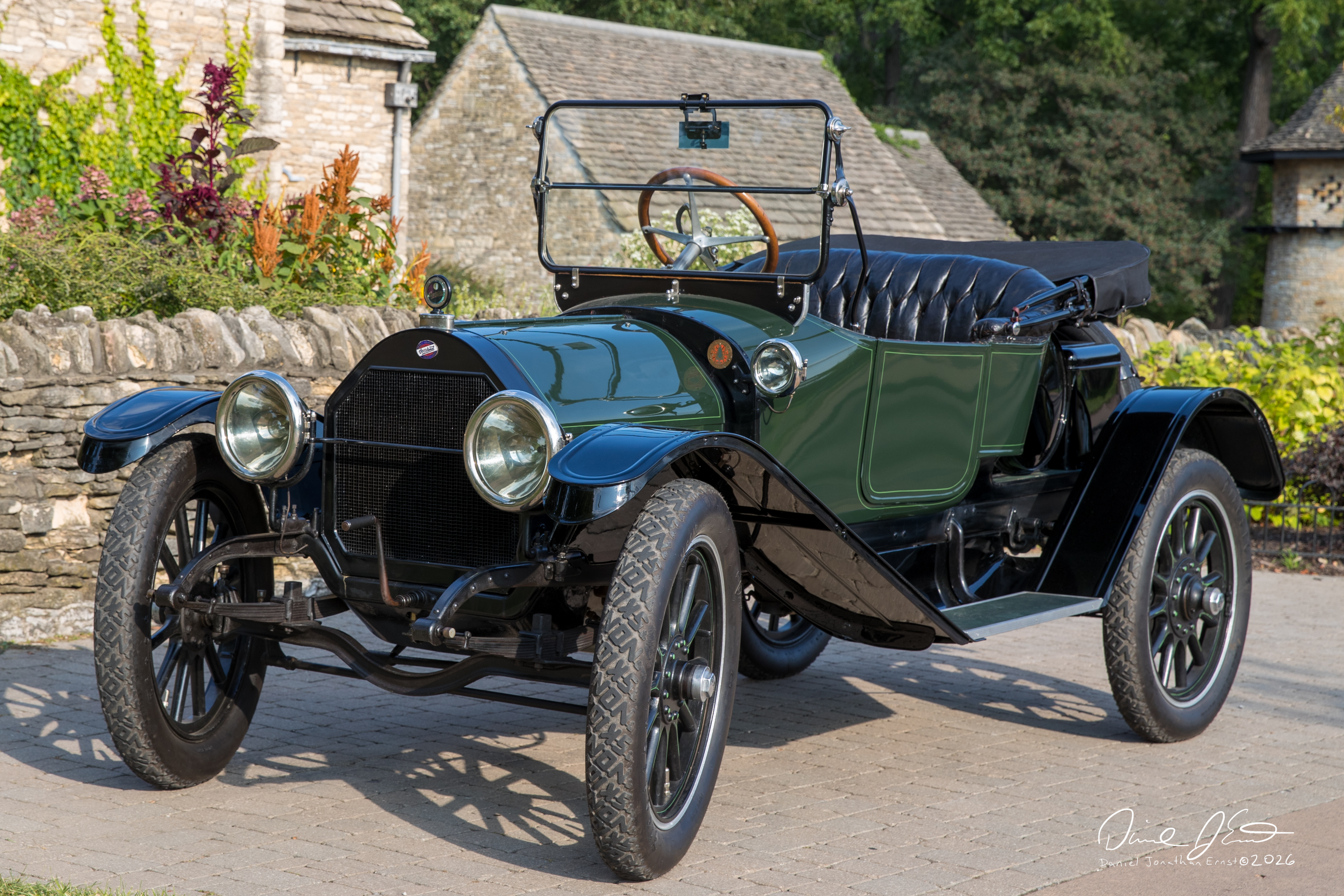
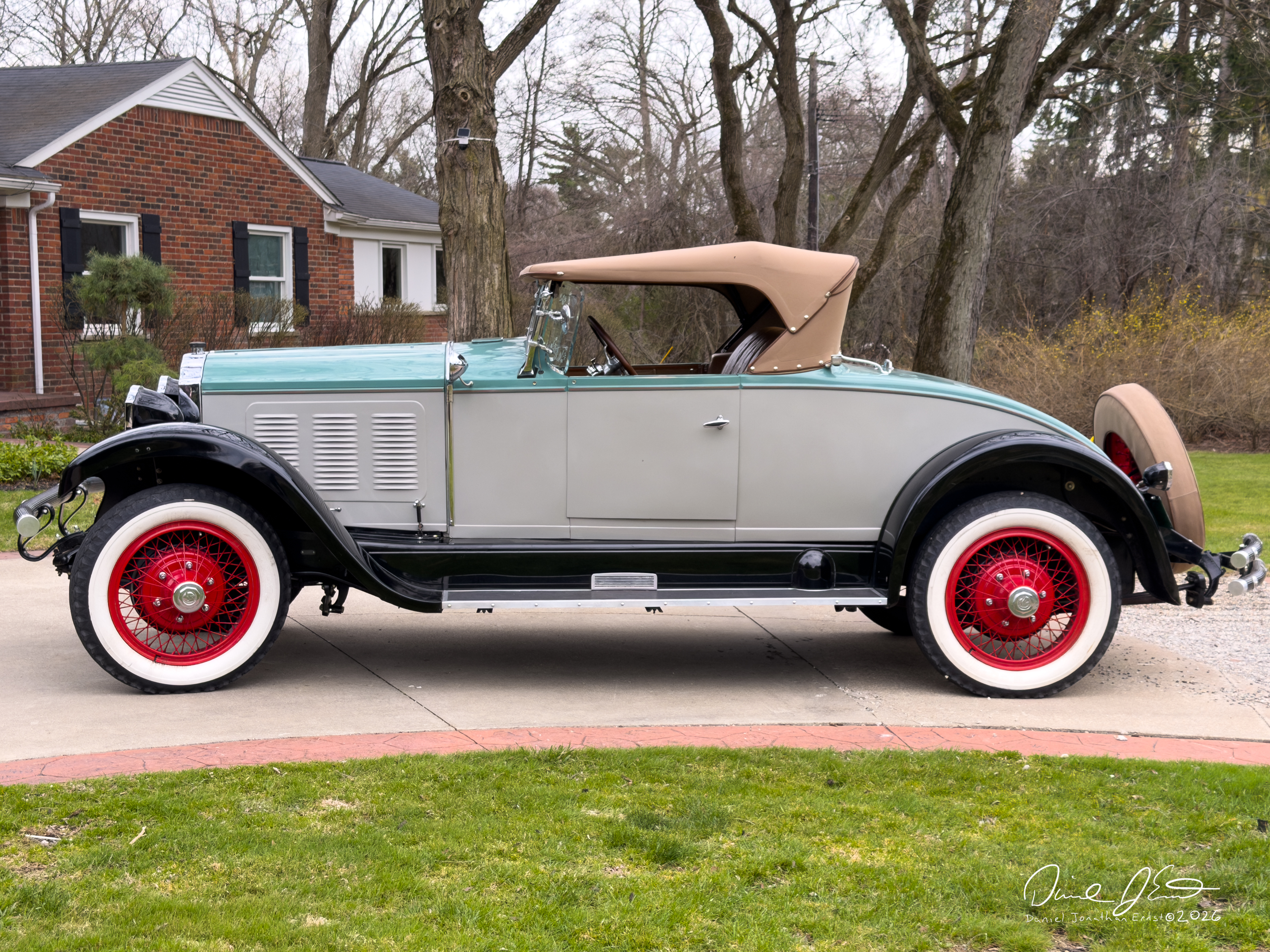
Willys-Overland's story starts not with John Willys building a car, but with him saving someone else's company — twice reorganized under his hand before it ever bore his name, and twice more after he'd left it. Two of the three cars in this collection, the Overland and the Willys-Knight, were built under this roof.
Founding & Rescue (1903–1909)
- Claude Cox built and test-drove the first Overland in Terre Haute, Indiana, on February 12, 1903. The Overland Automobile Co. was formally incorporated on March 31, 1906, backed primarily by Standard Wheel Company investor David M. Parry.
- John North Willys, then an automobile dealer in Elmira, New York, had ordered 500 Overlands in 1907 and advanced $10,000 against the order. The Panic of 1907 wiped out Overland's financing, and Willys arrived in Indiana to find the factory idle, cars unfinished, and the company a single day from missing payroll by $350.
- With the banks locked down for the weekend, Willys personally arranged emergency credit to meet that payroll, then persuaded creditors owed roughly $80,000 to accept stock and reduced terms rather than force the company into liquidation.
- With no factory space to spare, Willys pitched two circus tents outside the plant as makeshift assembly lines. Working under canvas, the company built and shipped 465 cars in 1908 and turned a $50,000 profit — the reorganization was complete by January 1908, and the company took the Willys-Overland name.
- In 1909 Willys bought the former Pope Motor Car Co. plant in Toledo, Ohio, for $285,000. The company moved its headquarters there that October, and Toledo has been home to Willys-built vehicles ever since — the same complex builds Jeep Wranglers today.
Rise to America's No. 2 Automaker (1909–1926)
- By 1911, Willys-Overland production reached 18,745 cars, trailing only Ford's 34,979. By 1912 — the year the company formally adopted the Willys-Overland name — annual production hit roughly 26,000 units, a rank as the country's second-largest automaker that the company held through 1918.
- The Willys-Knight line, licensing Charles Knight's sleeve-valve engine design, launched in 1914 and ran until 1932; the marque built more sleeve-valve engines than nearly every other manufacturer in the world combined.
- Between August 1919 and May 1926, Willys-Overland's four-cylinder Model 4 and its successors (4A, 91, 91A, 92) — including the Overland 79 in this collection — totaled roughly 642,000 cars built.
- In June 1926 the Overland nameplate was retired in favor of the smaller, European-influenced Whippet, briefly the best-selling car in America in 1927, outselling both Ford and Chevrolet in some months.
Depression & Bankruptcy (1926–1936)
- John Willys sold his stake in the company in 1929 for $25 million, after a record production year of over 314,000 cars, and went on to serve as the first U.S. Ambassador to Poland from 1930 to 1932.
- The 1929 crash hit hard: Willys-Overland lost roughly $35 million between 1930 and 1932 alone, and Whippet production ended in 1931.
- Willys returned from Poland to a company in serious financial trouble, and died of a heart attack in 1935 while helping oversee its reorganization.
- Willys-Overland went into receivership in 1933; the reorganization plan wasn't approved until 1936, when a new operating company, Willys-Overland Motors, Inc., took over manufacturing while a separate real-estate entity held the Toledo properties.
The Jeep & World War II (1936–1945)
- In June 1940, with war looming, the U.S. Army solicited bids for a light reconnaissance vehicle. Only three manufacturers responded: American Bantam, Ford, and Willys-Overland. Bantam built the first working prototype but lacked the capacity to produce at Army scale.
- Willys' entry, the "Quad," won out largely on the strength of its "Go-Devil" engine. The Army combined Bantam's drivetrain design, Ford's body configuration, and Willys' engine into a single standardized vehicle, and awarded Willys-Overland the production contract in July 1941. Ford was brought in later to help meet wartime demand, building a near-identical version under license.
- More than 647,000 of these light vehicles — nicknamed "Jeep" — were built during the war; Willys-Overland alone produced over 359,000 of them. It became the company's defining product for the rest of its existence.
Postwar & Legacy (1945–Today)
- Willys built the first mass-market civilian four-wheel-drive vehicle, the CJ ("Civilian Jeep"), starting in 1945, and trademarked the Jeep name in 1950.
- Kaiser Motors acquired Willys-Overland in 1953; the combined operation eventually took the name Kaiser Jeep Corporation.
- American Motors Corporation (AMC) bought the Jeep operation in 1970, and Chrysler in turn acquired AMC in 1987 — largely for the Jeep name.
- Jeep has since passed through Chrysler, DaimlerChrysler, Cerberus, Fiat Chrysler, and now Stellantis — but the Toledo, Ohio complex Willys built in 1909 still builds Jeep Wranglers today, in the same city where a bicycle salesman once rescued a stalled car company under two circus tents.
From This Collection
Two cars built under this roof