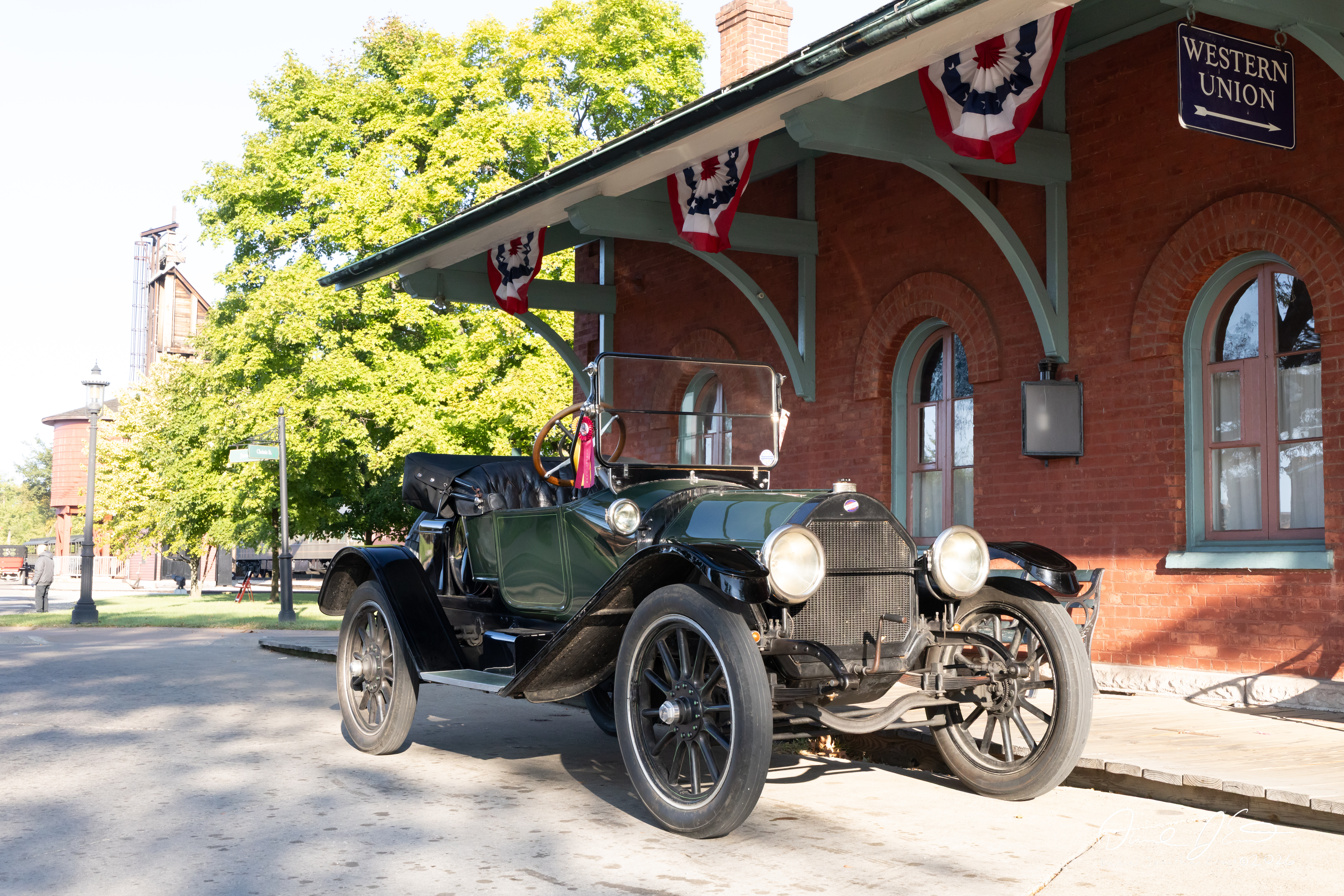
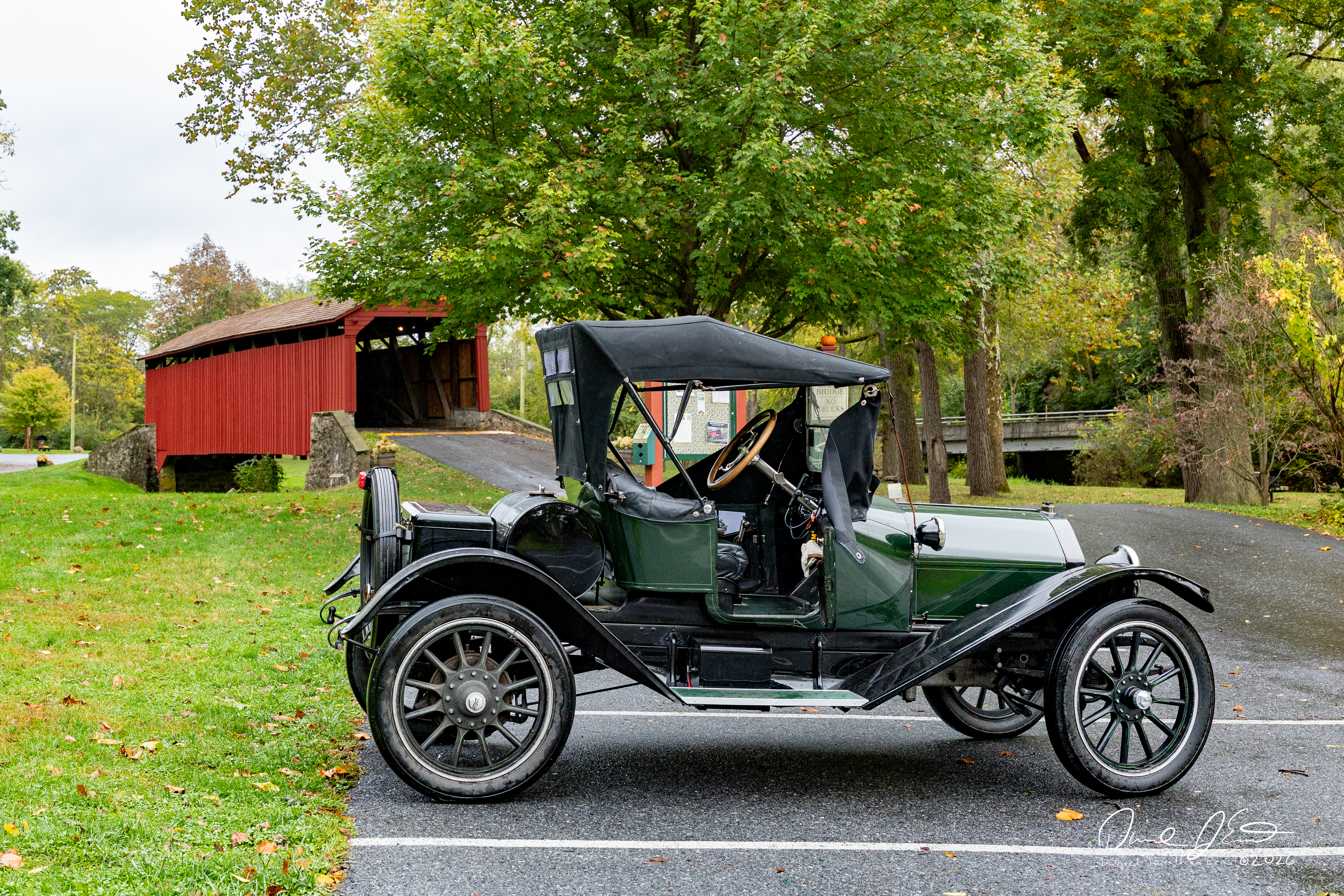
Specifications
As registered
Facts & History
Notes from the marque
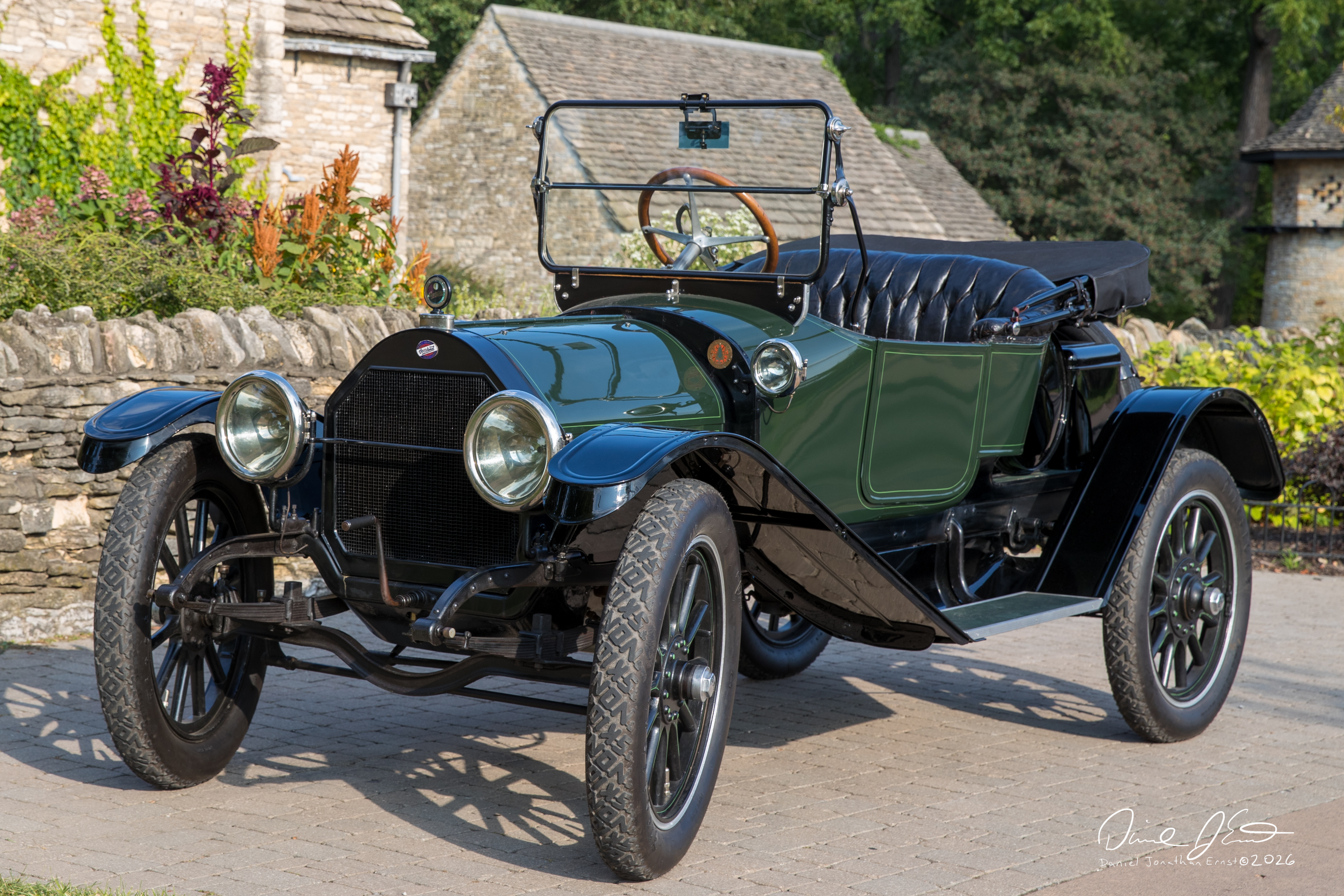
1914 was Overland's high-water mark: only Ford sold more cars in America that year, and the Overland cost roughly double a Model T for a more spacious, more powerful automobile aimed at buyers who wanted a step up from Henry Ford's utilitarian formula.
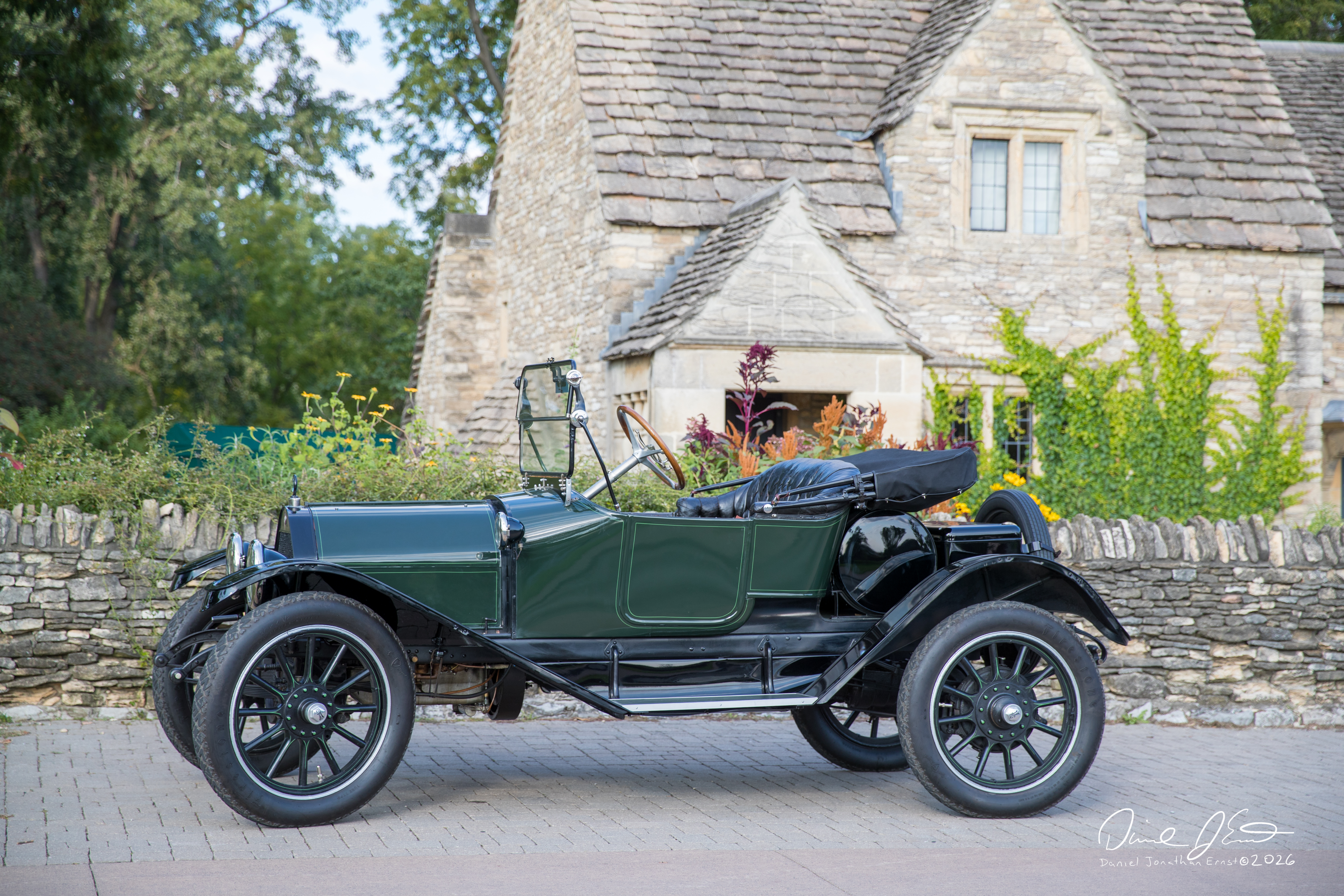
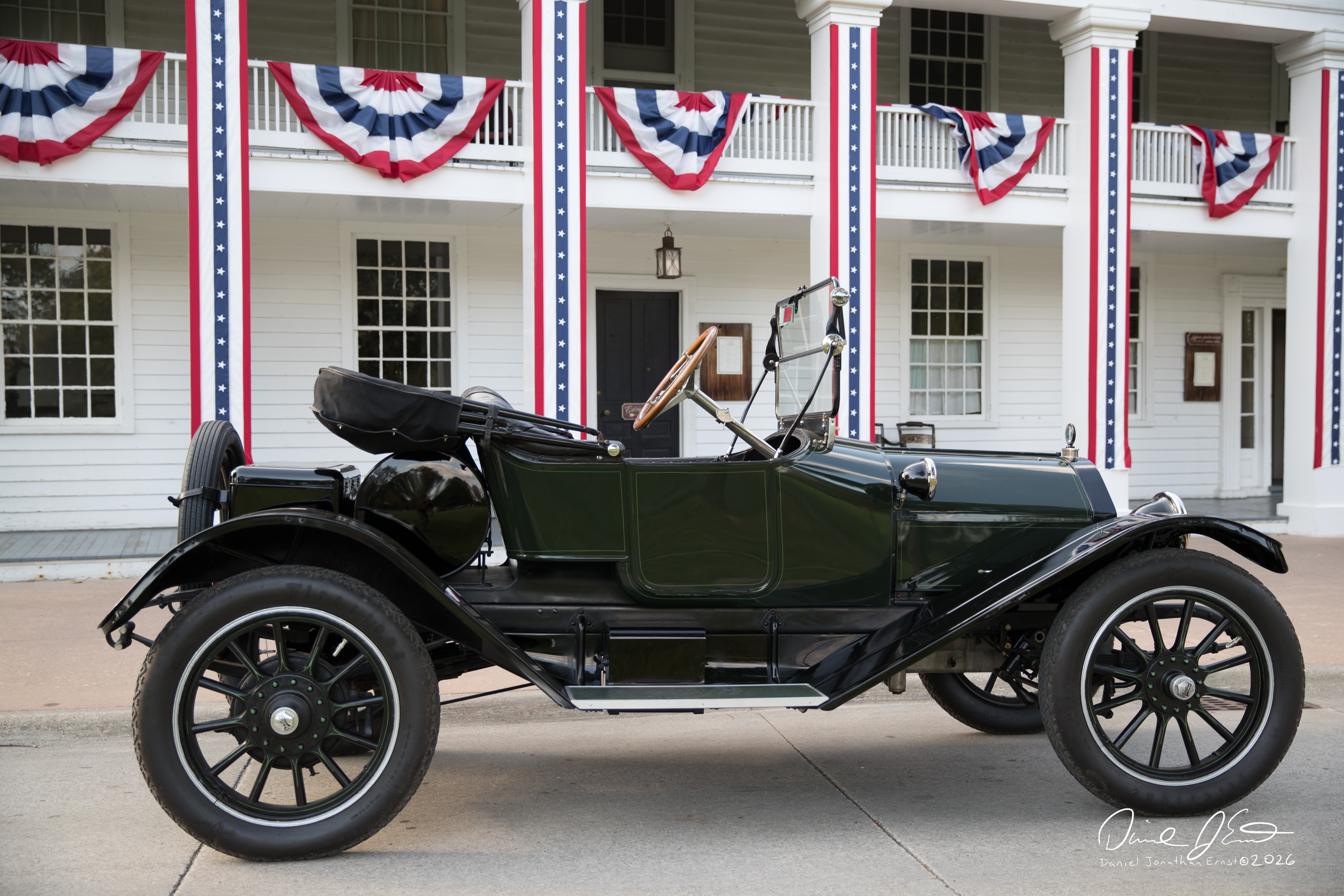
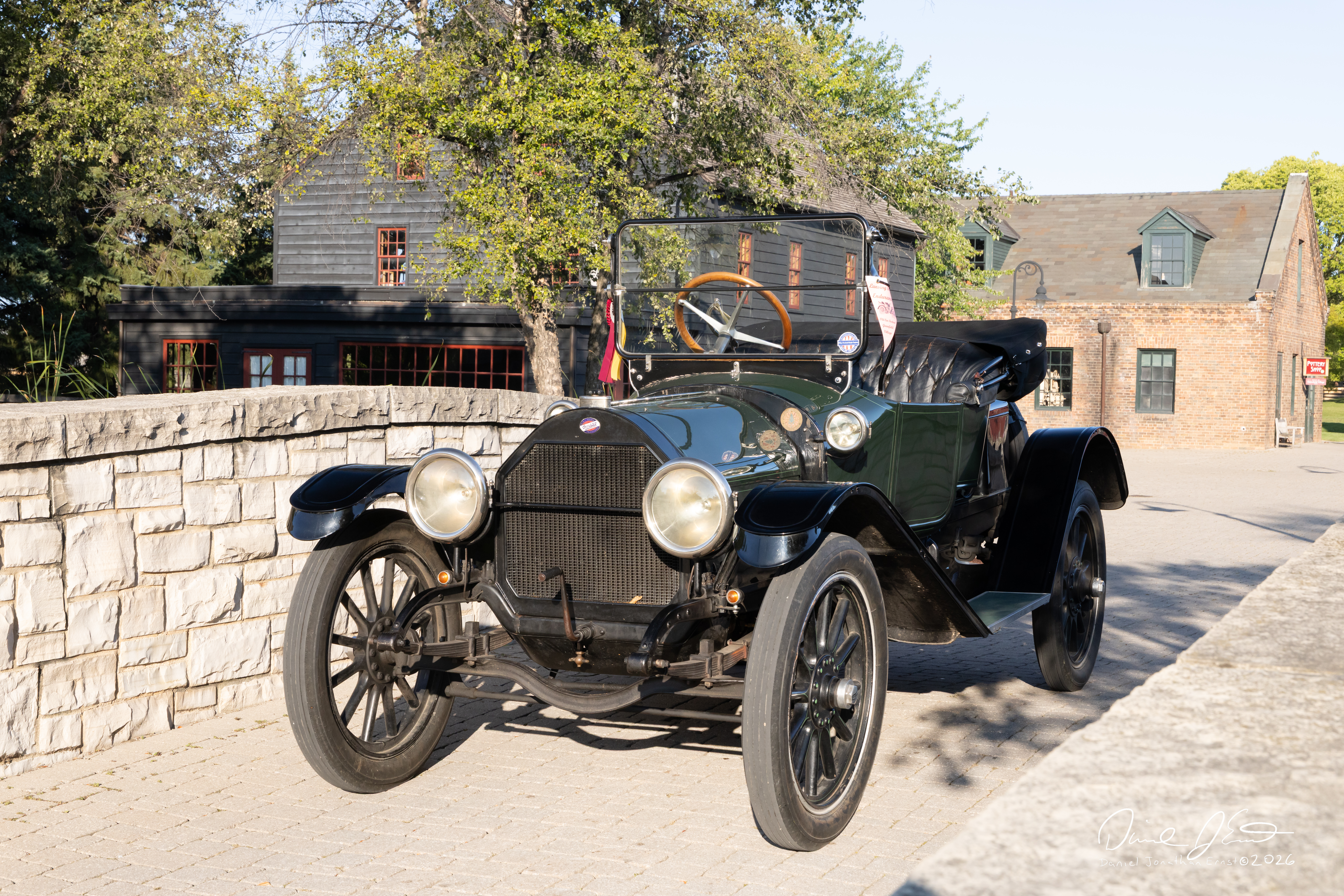
The 1914 Overland line offered three body styles built on shared mechanicals: a five-passenger touring car, this two-passenger roadster — marketed as "a touring car for two" — and a four-passenger inside-driven coupe. The touring car and roadster were mechanically identical, differing only in body and seating arrangement.
Design & Engineering
- Power came from a 35-horsepower four-cylinder engine with individually cast cylinder jugs — a more elaborate, and expensive, construction method than the Model T's single-block casting. Displacement is 240.5 cubic inches, with a bore of 4.125 inches and a stroke of 4.5 inches.
- The engine is hung in the frame on Overland's three-point suspension principle, making it an independent unit unaffected by the twisting of the frame over rough roads — keeping the crankshaft bearings in perfect alignment without frequent adjustment.
- The L-head cylinders are cast singly, with intake and exhaust valves on the left side for easy access and quick removal of the pushrods and pushrod guides. All motor parts are interchangeable, a design built around accessibility, durability, power, and silence.
- The engine uses a constant-level splash lubrication system, circulated by a gear pump, with a glass sight-feed visible to the driver under the cowl dash.
- The crankshaft rides in five main bearings — a total of 12 inches of its length is embedded in bearings — made possible by the single-cast cylinder design. This keeps the crankshaft aligned under stress that would throw a two- or three-bearing crankshaft out of line.
- The engine is cooled by unpressurized water circulating by thermal action rather than a water pump.
- The original Splitdorf magneto which provided ignition was replaced during an overhaul with a Bosch DU4 high tension magneto for improved performance.
- A Schebler L carburetor replaced the original during an overhaul. Fed by a large-capacity 32-gallon gasoline tank and getting about 10 miles to the gallon, this car will go over 300 miles between fill-ups.
- Drive from the engine to the differential runs nearly in a straight line through a single universal joint, minimizing friction loss between engine and rear wheels. The frame is cold-rolled pressed steel, hot-riveted, with reinforced angles.
- Willys-Overland operated the largest drop-forging plant in the auto industry at the time. The front axle is a one-piece I-beam, drop-forged without a weld — the factory catalog claimed none had ever been known to break. The rear axle is three-quarter-floating, combined into a unit with the transmission.
- The car is right-hand drive. There was no standard in 1914, so car manufacturers differed on which side they thought the steering wheel should be.
- The transmission is manual, with 3 forward speeds and reverse. The gears are not synchronized, so double-clutching is necessary when changing gears.
- This car travels comfortably down the road at 45 MPH, with a top speed around 55 MPH. Braking comes from two independent systems acting on the rear wheel hubs only (mounting 33 x 4 tires) — one pedal-operated, one lever-operated — so it is imperative to limit speed to safe road conditions.
- Steering is worm-and-worm-gear type, the worm forged integrally with the shaft and hardened, with grease-cup lubrication feeding the worm and shaft bearings directly. The 18-inch wheel is mounted on an aluminum spider.
- Wheelbase is 114 inches, with a 56-inch tread — Willys-Overland also offered a 60-inch "south" tread option, presumably suited to road conditions in that region.
Production, Pricing & Provenance
- This car is the 19,116th of 45,005 produced for the 1914 model year at the Willys Overland auto plant in Toledo, Ohio.
- This car cost $950 new, when the average annual income was around $690 (for a man). The factory catalog sold the Gray & Davis electric starter and generator only as a single $125 bundle ($1,075 total) — never separately — so a car ordered at the base $950 price, like this one, came with electric lights and a storage battery but no starter and no generator. It must be hand crank started.
- This car was purchased new in 1914 by J Hoadley of Middletown Springs, Vermont. He drove it about 22,000 miles until his death. The car changed hands three more times, and only driven about 600 more miles, when I purchased it in 2011. The car is now routinely driven on several car tours each year, often covering more than 100 miles a day for multiple days.
- The car is mostly original, including motor, body, frame, headlights, leather seat, wood floors, and dash instruments including speedometer. A new leather seat bottom and canvas top were made in the early 2020s. The original seat bottom and side curtains are safely stored.
- The motor, transmission, and rear axle were overhauled by David Liepelt in 2020.
The Overland Automobile Company was founded around 1903 by Claude Cox in Terre Haute, Indiana, and moved to Indianapolis in 1905. John Willys rescued the company from near bankruptcy in 1908, changed the company name to Willys-Overland, and moved production to Toledo, Ohio. By 1912, Willys had built the company into the country's second-largest automaker.
1914 was a transition year for trim: cars built that season moved from the brightwork of the true brass era toward nickel plating, and this Overland is trimmed in nickel rather than brass.
Photographs
Gallery